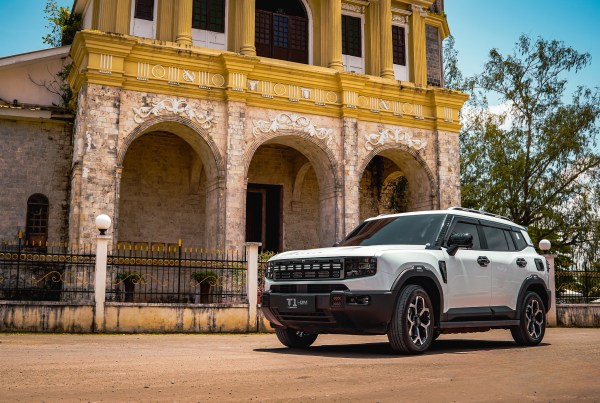

BYD Sealion 5 DM-i Review
The BYD Sealion 5 is in a slightly unusual position in BYD’s lineup. At ₱1.268 million, it’s priced surprisingly close to the much smaller Atto 2 DM-i. What’s even more unusual is that, despite being the more expensive model, the Sealion 5 actually gives up some features that you get on the cheaper Atto 2.
That makes its position in the lineup a little difficult to understand at first glance.

Exterior and interior
The Sealion 5 is slightly smaller than the Sealion 6, but it’s still a fairly substantial crossover. It’s also significantly larger than the Atto 2, which is immediately noticeable when you see the two cars side by side. And despite being BYD’s most affordable plug-in hybrid, it doesn’t really look or feel like an entry-level model.
The exterior looks good, but I think the interior is where the Sealion 5 really stands out. It looks premiu, the panels look nicely sculpted and almost everything is covered in soft-touch materials. There’s also a good amount of space inside. It doesn’t feel like BYD simply took a cheaper car and put a bigger body around it.


What’s interesting is how BYD chose to cut costs. The Sealion 5 gives up some basic convenience features that you’d expect almost every modern crossover to have like power folding mirrors and a 360 cam, but it still retains the things that make the car feel expensive.
Most manufacturers do the opposite. The more premium features are taken away first and the basic features go last.

Powertrain and EV range
The Sealion 5 uses BYD’s DM-i plug-in hybrid system, with a 12.96 kWh battery and a claimed 71 km NEDC EV range.
That’s less than the Sealion 6, which gets an 18.3 kWh battery and 105km of EV range, but significantly more than the Atto 2 DMi which has a 7.9kWh battery and 45km of range.
If you live in the city and your daily commute is within that electric range, you can do most of your everyday driving on battery power and simply charge the car when you get home.
The Sealion 5 produces 195 hp and 300 Nm, which is slightly less than the Sealion 6’s 214 hp and 325 Nm.
But again, the numbers don’t tell the whole story.
Living with it as a PHEV
One of the main reasons to get a plug-in hybrid is that, if you can charge at home, you can do most of your everyday driving using electricity.
So I did a couple of EV consumption runs to see how efficient the Sealion 5 actually is in the real world. In heavy city traffic, I averaged 15.4 kWh/100 km, while on the highway in EV mode, I got 12.5 kWh/100 km. Meralco currently charges about 15 pesos per kWh. Do the math and it’s significantly cheaper than running on gasoline, especially in heavy city traffic.
Those numbers make the Sealion 5 quite practical as a daily city commuter. If your daily driving stays within its 71 km EV range, the cheapest way to use the car is simply to drive it in EV mode and charge it when you get home. You can potentially do your everyday commute without using any fuel at all.
But what if you can’t charge at home, or you need to drive beyond the car’s electric range? In that case, I found that the best approach is to set the state of charge to 70% and let the car manage the balance between the engine and electric motor. The Sealion 5 does a pretty good job of deciding when to use battery power and when to use the engine, while keeping enough charge in reserve for situations where electric power is particularly useful, like heavy traffic.
I tested this on a trip from Quezon City to Laguna, starting with the battery at 70% and maintaining the state of charge at that level throughout the trip. With a mix of highway and city driving, I managed 31 km/L.
Sealion 5 vs Atto 2 DM-i
Sealion 5 vs Atto 2 DM-i vs Sealion 6
Comparing the Sealion 5 to the Sealion 6 is pretty straightforward. The Sealion 6 gives you more EV range and more features, including ADAS and a 360-degree camera, and that is reflected in its higher price. If you want the better-equipped car and don’t mind paying the extra money, go for the Sealion 6.


It’s not as straightforward when it comes to the Atto 2. Even though the Atto 2 is slightly cheaper, it actually has more features in some areas, including ADAS, a 360-degree camera, and power-folding mirrors. So on paper, the Atto 2 seems like it should have the upper hand. But this is where I think the Sealion 5 has some advantages that aren’t immediately obvious from the spec sheet.
I’ve driven both, and the Sealion 5 feels quicker, quieter and considerably more refined. It’s also significantly larger, with a more spacious interior and a longer EV range.
And that’s particularly important if you’re buying a plug-in hybrid. If your daily driving is within its 71 km EV range and you can charge at home, you can do most of your everyday driving without using fuel. Wheras the 45km range of the Atto 2 would mean that you would have to charge more often and some round trips from north to south of Metro Manila may not be doable on a single charge.
So the choice between the two really comes down to what you value more. The Atto 2 gives you more technology and convenience features, while the Sealion 5 gives you a larger, more refined car with more EV capability. And having driven both, I’d choose the Sealion 5.
So, is the Sealion 5 worth it?
The Sealion 5 doesn’t have all the features you might expect at this price. You don’t get things that you’d expect as a minimum, like power-folding mirrors or a 360-degree camera, for example. And with the Atto 2 DM-i now in the lineup, you can get a smaller crossover with more technology for less money.
But I don’t think the Sealion 5 is really competing with the Atto 2 in the way the spec sheet suggests. The Atto 2 is smaller and feels more budget-oriented, while the Sealion 5 feels much closer to the Sealion 6. In fact, I’d describe it as something like a more affordable Sealion 6, where you’re giving up some of the extra technology and convenience features to bring the price down.
And I think that’s what makes the Sealion 5 interesting. It gives up some of the basic features you’d normally expect an entry-level crossover to have, but it doesn’t scrimp on the things that make you feel good about the car you’re driving.
At ₱1.268 million, I think the Sealion 5 offers very good value. There are compromises, as you’d expect at this price, but I don’t think it compromises on the things that matter most in a plug-in hybrid: a usable EV range, a refined driving experience, and an interior that feels much more premium than the price suggests.
I think main competitor is the Changan Q05 but that’s a comparison that we’ll get into once I actually get to drive the latter.
for our full video review and driving impressions, watch the video below:
BYD Sealion 5 DM-i — Key Specs
- Price: ₱1,268,000
- Powertrain: Plug-in hybrid (DM-i)
- Battery: 12.96 kWh
- EV range: 71 km (NEDC)
- Power: 195 hp
- Torque: 300 Nm
- Fuel economy tested: 31 km/L (mixed city/highway)
- Charging: Plug-in charging
- Camera: Reverse camera
- Seats: Leather, manually adjustable
- Infotainment: Rotating touchscreen with Apple CarPlay & Android Auto
- ADAS: Not available
- 360° camera: Not available
- Power-folding mirrors: Not available